
With the rapid rise of electric vehicles (EVs), a new innovation may soon become a star in the evolving new energy ecosystem: the mobile charging robot.
China recently concluded its National Day holiday, during which EV charging issues—such as long wait times and the difficulty of finding available stations—once again became hot topics on social media. However, a new phenomenon also emerged: an increasing number of highway service areas began deploying a novel solution—mobile charging robots.
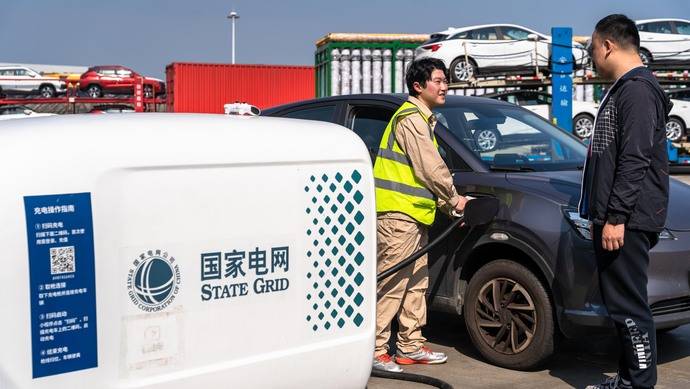
These robots were a fresh sight on Chinese highways during the holiday period, providing charging services to vehicles in line. Rather than waiting for an available charging station, drivers could now simply park their vehicles and wait for a mobile robot to deliver point-to-point charging.
As the EV market continues to grow rapidly and charging demand soars, mobile charging robots are set to become a vital supplement, offering commercial operations across a wide range of applications. Industry forecasts suggest that by 2025, the global market for mobile charging vehicles will reach a value in the tens of billions of dollars.
Experts note that the business model for mobile charging robots differs from traditional charging stations due to their core function as energy storage units. Beyond earning revenue from charging services, these robots can also be deployed for emergency vehicle assistance or even serve as a third-party power source for factories, shops, and homes.
However, the mobile charging robot industry is still in its early stages, and several challenges remain. High manufacturing and operational costs, limited application scenarios, a lack of regulations and standards, and insufficient government subsidies all hinder its development.
The Emergence of a New Charging Species
Mobile charging robots are an innovative technology designed to autonomously provide EV charging services. At locations equipped with these robots, drivers simply park and can summon a robot via an app or by scanning a QR code. The robot then moves to the vehicle and begins charging. Currently, there are two main types of mobile charging robots: one that is operated manually, which is the predominant product in the market today, and another that is fully autonomous. The latter, due to its high cost—ranging between 200,000 to 300,000 RMB ($30,000 to $45,000)—is primarily used in premium shopping malls and residential parking garages.
For example, the Shanghai Electric Power Company introduced smart mobile charging robots at the G60 Hukun Expressway Fengjing Service Area. Each robot has a capacity of 100 kWh and can charge an EV up to 80% in just 30 minutes. In another case, the State Grid Yangzhou Electric Power Company, in collaboration with emergency services, deployed a mobile charging robot at the Chenji Service Area on the S49 Xinyang Expressway. This robot has a storage capacity of 150 kWh and a maximum charging power of 60 kW, allowing it to fully charge four EVs, delivering a 400 km range in just 50 minutes.
A driver who used a mobile charging robot during the holiday commented, “The biggest concern with driving an EV is the long wait for charging, but now, with more charging stations and mobile power units like charging robots, this issue is being effectively addressed.”
Nevertheless, some experts caution that mobile charging robots currently have limited applications and are relatively expensive, with service fees higher than those of conventional public charging stations. As a result, they are mainly deployed in high-end residential areas or shopping centers in urban environments.
Complementing Traditional Charging Stations
The emergence of mobile charging robots reflects a broader issue: the current lag between the development of China’s charging infrastructure and the growth of the EV market.
As of the end of June 2024, China had 24.72 million registered EVs, accounting for 7.18% of the total vehicle population. In comparison, there were only 10.24 million charging points nationwide, with a vehicle-to-charger ratio of roughly 2.4:1. This mismatch highlights the urgent need for additional charging infrastructure.
Each mobile charging vehicle is estimated to reduce carbon emissions by approximately 50 tons annually. Despite these environmental benefits, the high costs of production and operation—largely due to expensive research and development, manufacturing, maintenance, and energy supply—remain obstacles. Industry analyses show that the initial investment for a mobile charging robot is 1.5 to 2 times that of a fixed charging station, but with advancements in technology and scaled production, costs are expected to decrease over time.
Besides cost challenges, the market for mobile charging robots also faces low public awareness and the absence of policies and standards. In China, while mobile charging robots have been deployed in numerous cities, many EV owners remain unfamiliar with the technology. A survey revealed that only about 10% of EV users were aware of mobile charging vehicles.
Volkswagen introduced the concept of mobile charging robots in 2018, allowing drivers to request a charging station delivery by phone. The company launched its first batch of mobile charging stations in Germany in early 2019. By 2021, Volkswagen rolled out a new concept involving autonomous robots that can connect, charge, and return mobile charging units.
In China, companies entered the field in 2020, followed by a wave of startups, energy companies, and automakers. According to research, over 40 companies in China are now involved in the mobile charging robot market by 2024.





 Volt's Next